Crash Bandicoot Built Naughty Dog
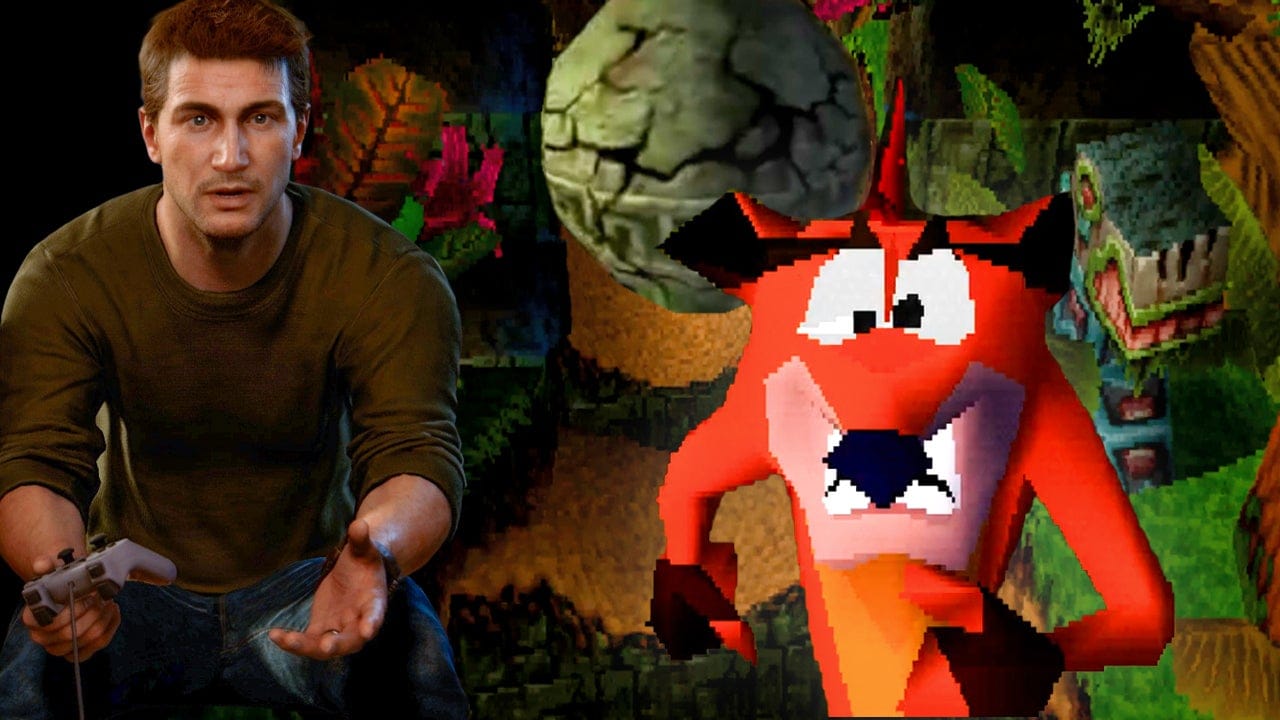
There is a specific kind of cinematic tension that grips us when a character runs directly toward the camera. Whether it’s a thrilling escape from a giant statue or a desperate sprint through a plague-infested rat swarm, the running-towards-camera chase sequence has become a cinematic staple in video games. But where did this dramatic trope come from? The answer is surprisingly rooted in a colourful, chaotic platformer: Crash Bandicoot.
While the chase sequence is now ubiquitous in blockbuster games, its humble beginnings were driven by a single, seemingly simple goal: how to make a character’s face emote. The developers at Naughty Dog, working on Crash Bandicoot, were trying to solve the challenge of giving their star character genuine expression. This early effort led to a revolutionary level design that would eventually inspire decades of cinematic level architecture.
Consider the level Boulders in Crash Bandicoot. Taking about sixty seconds to complete, this level might not seem like a highlight reel moment, but it was the first instance of a character running toward the camera. This simple act of perspective shift laid the groundwork for the dynamic action we see today. It immediately inspired the entire trajectory of the Crash series, and perhaps most famously, the Naughty Dog Uncharted franchise, where Nathan Drake repeatedly runs toward the lens.
The history of this perspective shift is a fascinating blend of artistic ambition and technical necessity. Early attempts to implement 3D platforming in Crash Bandicoot presented a fundamental dilemma: the camera was always behind the character, meaning players only saw the character’s backside. To truly sell Crash as an emotive character—a friend with a personality—the developers needed to show that face. This drove them to experiment with novel approaches to perspective.
The team recognized that the solution lay in flipping the script. Instead of simply running away, they experimented with making the character face the player. They introduced 2D levels to allow players to see Crash in familiar poses, and they pioneered the “running into the screen” mechanic. This move transformed the perspective, forcing the character to confront the player, thus creating genuine dramatic tension.
This shift was essential, but it brought new challenges. When players were running into the unknown, the level design had to adapt. The environment needed to feel threatening yet fair. The team realized that simply adding a third dimension—the space itself—diluted the sense of conflict. To maintain the action pace, they had to adjust the geometry and the obstacles to keep the stakes high, proving that the best chases are born from effective gameplay, not just clever angles.
By experimenting with this dynamic balance, the developers forged the blueprint for modern action games. They introduced a philosophy of adaptive difficulty, learning that game design could evolve to accommodate player skill. This approach—balancing challenge with approachability—became a cornerstone of the Naughty Dog ethos.
The enduring legacy of Crash Bandicoot is more than just a beloved platformer; it is the crucible in which the Naughty Dog philosophy was forged. The ambition to create truly great games, coupled with the risk taken to pursue stunning 3D facial animations and revolutionary chase sequences, established Naughty Dog as an elite developer. It is a testament to how a single, humble game can inspire an entire cinematic era.
Buy on Amazon
Credit
