
Inventor creates IRL game shelves for digital discs
For retro console enthusiasts, the thrill of physical games is undeniable. Yet, managing those collections often involves a tedious reality: flipping through spines and labels to find the next adventure. What if you could bring the seamless experience of a digital home screen to your physical shelf?
A new invention is taking that exact concept off the drawing board, creating what is being dubbed the “IRL Homescreen.” This project merges the tactile satisfaction of physical game boxes with the instant navigation of a modern digital interface.
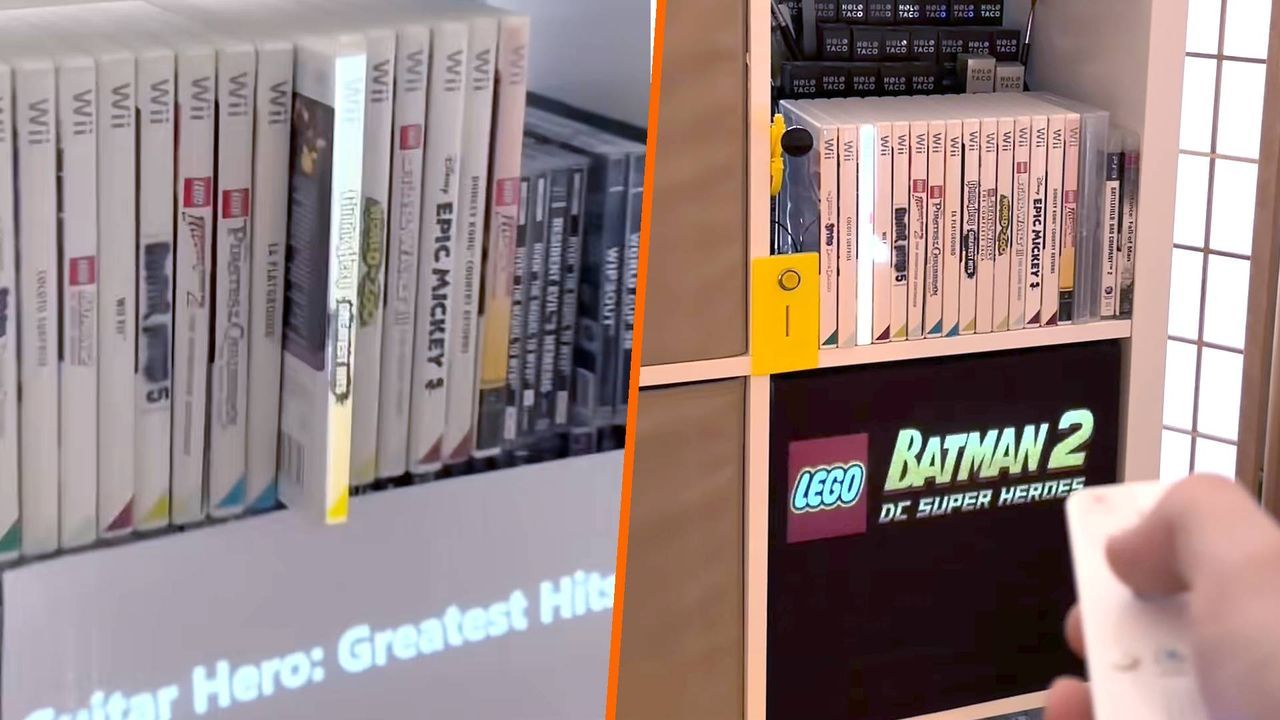
The result is an ingenious setup that transforms a row of boxed games into a navigable digital library. How does it work? The system utilizes a projector paired with a rail mechanism, designed to make Wii game boxes glow upon selection before they are pushed forward, with the corresponding artwork displayed underneath.
This means you can interact with your collection using a controller or a Wiimote, effectively achieving a virtual game selection experience that exists in the real world. While it might seem a little silly to use your eyes alongside a controller, for those who struggle to process dense spine labels, it offers a wonderfully intuitive shortcut.
Underneath this clever display lies some impressive engineering. The system is powered by a laptop connected to an ESP32-C3 Robot control board, which uses Wi-Fi and Bluetooth to translate controller presses into specific vertical positions. This input activates the back rail mechanism, causing only the desired game box to highlight and project its artwork.
The technology demonstrates an impressive approach, as it relies purely on positioning and light projection rather than detecting individual boxes. However, the current proof-of-concept is confined to a smaller arrangement, typically within a unit like an IKEA KALAX shelf.
Scaling this concept up presents some technical hurdles. Adding more games and shelves would introduce complexities regarding accuracy—ensuring perfect alignment for projected animations—and managing multiple layers of projection across different shelves. But the potential payoff is massive: it could significantly challenge the notion that physical media is a necessary constraint when we consider modern library convenience.
Beyond simple selection, the system even includes a slot-machine-style lever that allows for random selection, saving users from having to make tedious choices before starting a session. The future possibilities are exciting; developers are exploring ways to harness homebrew applications and hand tracking—as seen in experiments involving “the force”—to further unlock new functionalities.
As creators continue to refine the IRL Homescreen project, we can anticipate a true revolution where physical collections meet digital ease, turning game shelving into an interactive portal for nostalgic fun.
Buy on Amazon
Credit